

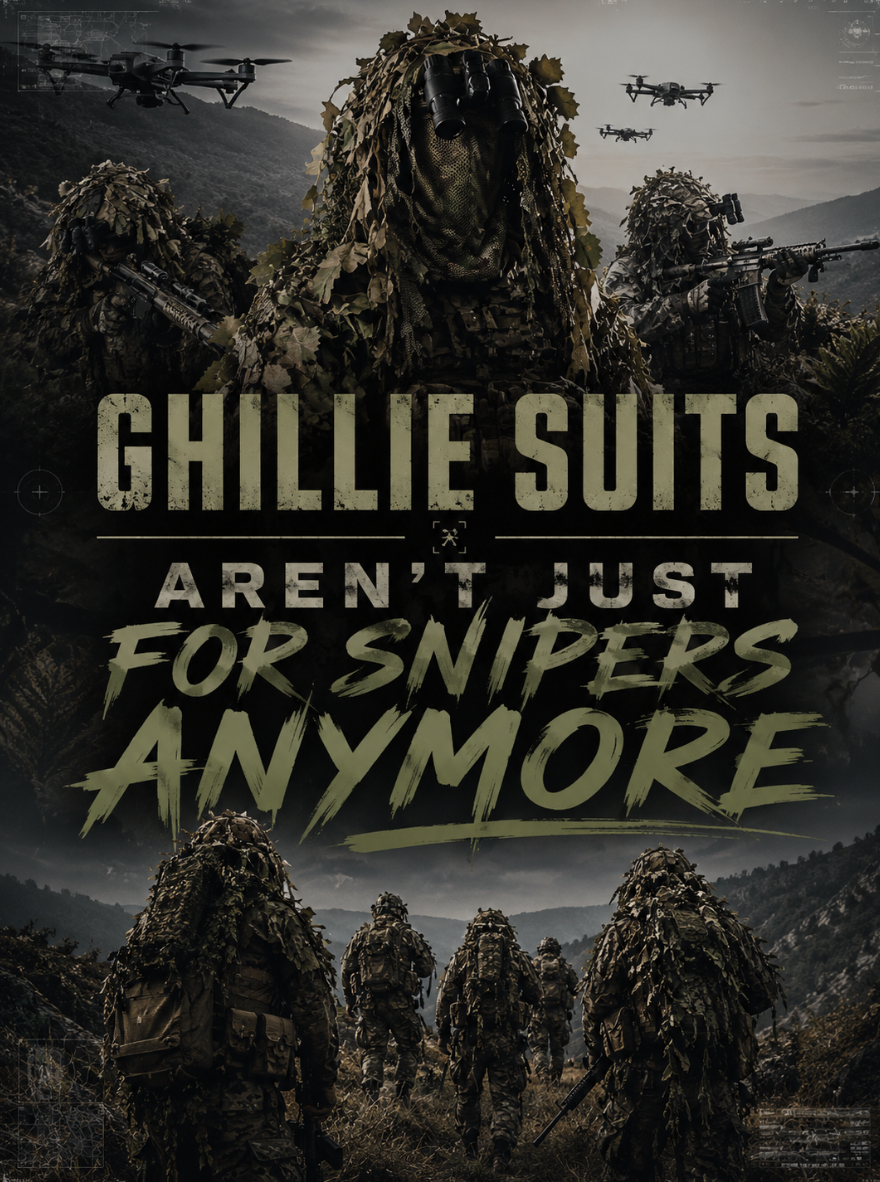
For decades, the ghillie suit was closely associated with one military specialty: Snipers. Images of highly trained marksmen disappearing into the terrain helped cement the ghillie suit as a niche tool reserved only for long-range precision shooters. However, the battlefield has changed. Modern concealment is no longer just a sniper concern, it has become a survival requirement for infantrymen, reconnaissance teams, assaulters, forward observers and virtually anyone operating in open environments and terrain. The reason is simple: the sky is full of sensors.
Small unmanned aerial systems (sUAS), military reconnaissance drones and thermal-equipped drones have changed how combat personnel are detected and targeted. A soldier may be hidden from ground observers but still easily identified from above by visual, near-infrared (NIR) or thermal imaging systems. As a result, camouflage must now extend beyond traditional visual concealment.
Modern operators need to manage their visual signatures across multiple spectrums:
- VIS (Visible Spectrum): What the human eye sees.
- NIR (Near Infrared): What night vision devices detect.
- Thermal (TIR): Heat signatures visible through thermal imagers.

Traditional camouflage uniforms alone fail to address all three. Effective concealment requires multispectral signature management that disrupts outlines, reduces recognizable shapes and mitigates thermal detection. As drone technology becomes more accessible and widespread these considerations are increasingly relevant for all combat arms personnel, not just snipers.
The End of the “Sniper-Only” Ghillie Suit
Drone operators can scan large areas in minutes, identify movement and relay target information almost instantly. A machine gun team, reconnaissance patrol, anti-armor team or assault force may be under observation long before making contact with the enemy. This has led to the evolution of lightweight concealment systems designed for mobility. Instead of the heavy burlap ghillie suits of the past, modern systems focus on:
- Lightweight construction
- Modular configurations
- Improved breathability
- Equipment compatibility
- Enhanced visual outline breakup
- Multispectral signature management
These features allow concealment systems to be integrated into everyday combat operations rather than reserved for specialized sniper missions.
Predator Ghillie™ Concealment System
The Beez Combat Systems Predator Ghillie™ Collection exemplifies this shift in thinking. Rather than a single suit, the Predator Ghillie™ system is designed as a scalable signature management system intended for general combat applications. Components include helmet covers, backpack covers, concealment hoods, thermal reduction packs, veils and modular wrap systems that can be tailored to mission requirements.
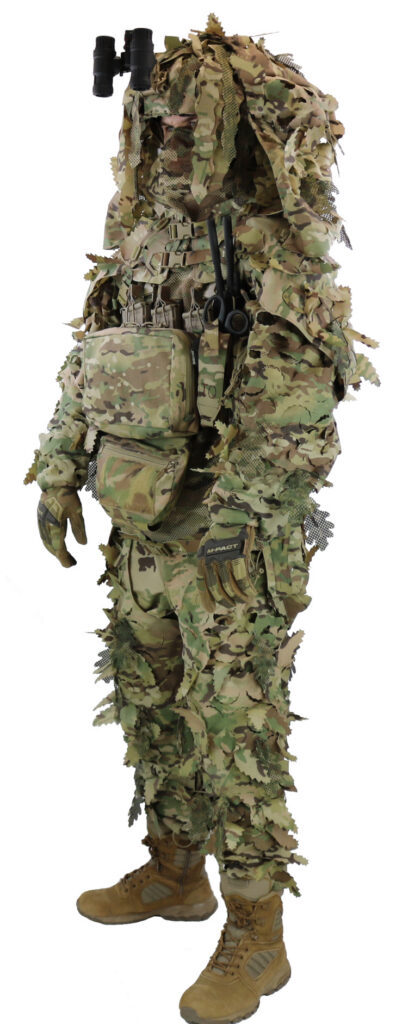
The Predator Ghillie™ system focuses on multispectral concealment and outline disruption, assisting users reduce their visibility across visual, NIR, and thermal spectrums. Products within the Predator Ghillie™ SPECTRALFLAGE line are specifically designed to help mitigate detection from thermal devices while still providing effective visual camouflage. This approach reflects a growing reality acknowledged throughout the tactical community: concealment is increasingly viewed as an essential capability for a wide range of operators. Discussions among the military community frequently center on not only visual camouflage but also NIR and thermal performance when evaluating modern concealment systems.
Concealment Is Now Essential for Battlefield Survival
The evolution of drone technology has transformed camouflage from a specialty skill into a battlefield necessity. Whether you’re conducting reconnaissance, assaulting an objective, establishing an observation post or maneuvering with a rifle squad, the ability to manage your visual, infrared, and thermal signature can significantly affect survivability.

